English ![]()

No.7 Wolong Middle Road, Wolong Economic Park, Zhifu District, Yantai City, Shandong Province

Views: 0 Author: Site Editor Publish Time: 2026-10-21 Origin: Site
Processing fine yarn in high-speed circular knitting environments leaves zero margin for error regarding needle geometry and micro-tolerances. Utilizing incorrect hook dimensions for fine counts directly results in yarn breakage, dropped stitches, machine downtime, and compromised fabric yield. Fine yarns, such as microfibers, fine cotton, or low-denier synthetics, demand exact mechanical handling. You must establish a technical framework for evaluating needle specifications to maintain production efficiency. Matching machine gauge to yarn count, mitigating thermal expansion, and selecting the optimal hook profile ensure continuous, defect-free production. We will break down the engineering principles behind hook geometry and provide actionable steps for optimizing your knitting floor.
Hook Volume is Critical: The inner volume of the needle hook must precisely accommodate the fine yarn's diameter without causing filament abrasion or allowing the yarn to escape during the knitting cycle.
Gauge and Needle Synchronization: High-gauge machines require specialized fine yarn needles with optimized latch and hook dynamics to handle rapid stitch formation and tight clearances.
Component Specifics Matter: Models like the VOSASPEC 80.85D Circular Knitting Needle offer specific geometric advantages for fine yarn, but must be evaluated against machine operating speeds, thermal dynamics, and fabric tension requirements.
Wear, Heat, and Maintenance: Fine hooks are inherently more susceptible to wear, fatigue, and heat accumulation; selecting needles with appropriate steel alloys and friction-reducing coatings is essential for long-term ROI.
Successful fine yarn processing requires consistent loop formation, zero filament damage, high machine efficiency, and thermal stability. These baseline requirements dictate every mechanical decision on the knitting floor. Fine yarns lack the tensile strength and bulk of coarser counts. They cannot absorb mechanical shocks or tolerate rough handling during the stitch formation cycle. The needle must guide, pull, and release the yarn with absolute precision. When running a 34-inch cylinder at 35 RPM, each needle executes the stitch formation cycle over a thousand times per minute. At these velocities, the physical interaction between the yarn and the steel dictates your first-quality fabric yield.
The physics of the yarn entering the hook govern the entire knitting process. During the clearing phase, the old loop slides down the needle stem. The new yarn then feeds into the open hook. Finally, during the knock-over phase, the latch closes, and the needle pulls the new yarn through the old loop. The hook size must match the yarn diameter perfectly. If the hook is too large, the yarn experiences instability. It shifts inside the hook cavity, leading to uneven loop lengths and fabric ballooning. The yarn may even roll out of the hook before the latch secures it.
Conversely, a hook that is too small causes catastrophic failures. The tight space pinches the yarn, causing filament splitting and high-tension breakage. The metal edges shear the delicate fibers, generating excessive lint. Yarn twist also interacts heavily with hook geometry. High-twist yarns, whether S or Z twist, carry internal torque. A properly sized hook stabilizes the yarn, preventing it from un-twisting or snagging during loop formation. An incorrect hook allows the torque to distort the stitch, creating skewed fabric that fails dimensional stability tests during the finishing process.
Poor needle matching manifests immediately in the fabric. Operators must recognize these defects and trace them back to the mechanical root cause at the needle level.
Barre Effects: These horizontal bands occur when inconsistent hook volumes draw uneven yarn lengths. A batch of needles with slight variations in hook inner diameter will pull different amounts of yarn, changing the stitch density across specific courses.
Pinholes: These tiny holes appear when a hook drops a single filament from a multi-filament synthetic yarn. If a 20-denier/36-filament polyester yarn enters a hook that is too wide, the filaments spread flat. The closing latch spoon pinches and cuts a few filaments, weakening the loop until it bursts.
Vertical Lines: These form when a specific needle hook bends slightly, altering the stitch density in that single wale. Fine hooks lack the mass to resist bending if yarn tension spikes unexpectedly.
Elastane Plating Failures: When knitting fine cotton with a bare elastane core, the hook must keep both yarns perfectly parallel. An oversized hook allows the elastane to roll over the cotton, exposing the shiny synthetic thread on the fabric face.
Machine stops drive up operational costs rapidly. Incorrect hooks generate excessive lint by abrading the yarn surface. This lint accumulates in the needle tracks and cam boxes, eventually causing latch malfunction. When lint packs under the latch spoon, it prevents full closure. The open latch then crashes into the yarn feeder or cam profile, leading to needle head decapitation. Replacing smashed needles consumes valuable production time and requires recalibration of the affected feeders.
Translating physical needle measurements into production outcomes requires a systematic approach. You must evaluate how the hook geometry interacts with the specific denier of your yarn. The goal is to maximize fabric quality while minimizing mechanical wear across the entire cylinder.
Standard hook profiles generally fall into two categories: forward hooks and central hooks. Forward hooks position the tip closer to the cylinder center. Central hooks align the tip directly over the needle stem. Low-denier yarns typically require central hooks to maintain balanced tension during the downward pull. The inner shape of the hook also plays a critical role. U-shaped hooks offer a wider bottom, accommodating thicker or bulkier yarns. V-shaped hooks taper at the bottom. Fine filaments require a V-shaped inner profile. This geometry forces the fine yarn into the exact center of the hook, ensuring perfect alignment during the knock-over phase and maintaining strict stitch uniformity.
The physical dimensions of the hook wire also matter. For fine gauge applications, the wire diameter forming the hook might be as thin as 0.3mm. This requires exceptional metallurgical control to prevent the hook from snapping under the dynamic load of the knitting cycle.
Aligning Circular Knitting Needle Hook Sizes with specific machine gauges forms the foundation of fine knitting. High-gauge machines, ranging from 28G to 44G, pack more needles per inch. This density leaves very little physical space for the needle head. Textile engineers use empirical formulas to calculate the maximum yarn capacity per hook size. Generally, the yarn diameter should occupy no more than 60% of the hook's inner width.
Machine Gauge (E) | Typical Yarn Denier | Recommended Hook Inner Width (mm) | Latch Spoon Width (mm) |
|---|---|---|---|
28G | 50D - 75D | 0.40 - 0.45 | 0.50 |
32G | 30D - 50D | 0.35 - 0.40 | 0.45 |
36G | 20D - 30D | 0.30 - 0.35 | 0.40 |
40G | 15D - 20D | 0.25 - 0.30 | 0.35 |
44G | 10D - 15D | 0.20 - 0.25 | 0.30 |
For a 36G machine running 30-denier polyester, the hook inner diameter must be micro-engineered to prevent the yarn from flattening out. You must cross-reference the machine manufacturer's gauge recommendations with the specific yarn count to select the correct hook volume. Deviating from these tolerances guarantees fabric defects.
High-speed knitting generates intense friction-induced heat. A 40-inch cylinder running at 35 RPM forces thousands of needles through the cam tracks every second. This friction heats the needle metal, causing micro-expansion. While the expansion is microscopic, it significantly alters the operating clearances in high-gauge machines. You must account for thermal expansion when selecting hook sizes.
If the hook expands too much, the clearance between the hook tip and the closed latch spoon disappears. The latch binds against the hook tip, failing to open during the clearing phase. Selecting needles with engineered thermal stability prevents this binding and ensures smooth latch operation at high operating temperatures. Proper cylinder lubrication also plays a massive role in managing this thermal load, pulling heat away from the needle stems before it reaches the hook.
High-performance needles designed for micro-denier processing incorporate specific engineering features. These features address the unique challenges of handling delicate yarns at extreme speeds. Evaluating these specifications helps you choose the most durable components for your specific production run.
The base material of the needle dictates its lifespan. Specialized, high-carbon steel alloys are mandatory for preventing hook deformation under high-speed stress. Fine hooks possess less metal mass than standard hooks, making them highly susceptible to bending. High-carbon steel provides the necessary rigidity. Manufacturers often temper the hook to a hardness of around 60 HRC while keeping the stem closer to 45 HRC. This dual-tempering process ensures the hook resists wear while the stem remains flexible enough to absorb the shock of the cam track.
Surface treatments further enhance performance. Choosing the right coating for your Fine Yarn Circular Knitting Machine Needles depends entirely on the abrasiveness of your yarn and the operating speed of your machine.
Chrome Plating: Offers a hard, smooth surface (typically 2-3 microns thick) that reduces friction and prevents oxidation.
Titanium Nitride (TiN): Provides superior wear resistance, ideal for abrasive yarns like dull polyester or nylon containing titanium dioxide matting agents.
Tungsten Carbide: Dissipates heat rapidly and prevents static buildup when processing synthetic fine yarns at maximum RPMs.
The latch spoon design determines how smoothly the needle closes. An aerodynamic latch profile cuts through the air and lint accumulation efficiently. The spoon must seat perfectly over the fine hook tip. Precise latch seating prevents fine yarn from being pinched, cut, or trapped during loop closure. If the spoon is too wide, it strikes the adjacent needles in high-gauge cylinders. If it is too narrow, it fails to cover the hook tip completely, allowing the fine filaments to snag.
The pivot pin of the latch must also withstand millions of rapid oscillations without loosening. A loose latch bounces during the knitting cycle. Latch bounce causes the spoon to flutter open slightly just as the yarn is supposed to be knocked over, causing random dropped stitches and fabric defects. High-quality fine yarn needles utilize precision-stamped pivot pins to eliminate this lateral play.
Analyzing a known industry specification provides practical context for fine yarn applications. We will examine the operational benefits and structural design of a specific needle profile to understand how engineering translates to the knitting floor.
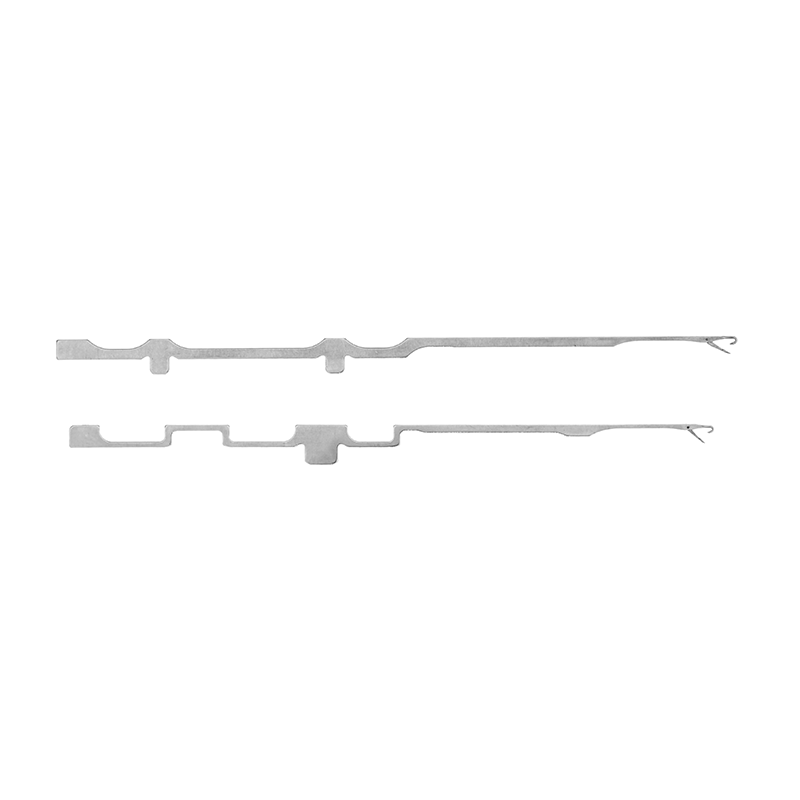
The exact dimensional specifications of the VOSASPEC 80.85D Circular Knitting Needle cater strictly to fine gauge knitting. This model features a highly optimized hook geometry designed to secure low-denier filaments. It incorporates a reduced cheek thickness. The cheeks are the flat sides of the needle head below the hook. Thinner cheeks allow the needle to operate smoothly in the tight slots of a 36G or 40G cylinder without generating excessive friction against the trick walls.
The optimized latch length ensures rapid closure, minimizing the time the hook remains open. This rapid action is critical for securing fine yarns before they can escape the hook cavity. The inner hook volume is precisely calibrated to hold a specific denier range, preventing the yarn from flattening and splitting during the downward stroke.
This specific needle profile excels with high-margin fabric outputs. It handles elastane blends, fine combed cotton, continuous filament synthetics, and micro-modals with high precision. The V-shaped inner hook aligns bare elastane perfectly with the ground yarn, making it ideal for seamless intimate apparel and fine gauge activewear.
Medical textiles, which require absolute stitch uniformity and zero contamination, also benefit from this precise hook geometry. The needle prevents filament shearing, ensuring the final fabric maintains its intended tensile strength and smooth hand feel. When knitting compression garments, the consistent hook volume guarantees that the compression rating remains uniform across the entire fabric roll.
Evaluating the cost-to-lifespan ratio requires understanding conceptual trade-offs. Extreme precision needles command a higher upfront cost. They also demand stricter maintenance protocols and cleaner operating environments. However, they unlock maximum production speed capabilities for fine yarns.
Standard needles may cost less initially, but they force you to run the machine at lower RPMs to prevent yarn breakage. The VOSASPEC profile balances this by offering a hardened hook that resists wear while maintaining the slim profile needed for high-gauge work. You must weigh the initial component cost against the reduction in machine downtime and the increase in first-quality fabric yield. Fewer machine stops for broken needles directly translates to higher daily output.
Adopting fine-hook needles on the factory floor introduces specific operational risks. You must implement practical strategies to ensure continuous uptime and protect your needle investment.
Fine hooks exhibit heightened sensitivity to yarn tension spikes and input variations. A sudden increase in tension can easily bend a micro-hook or snap the yarn. You must utilize positive yarn feeding systems to deliver yarn at a constant, controlled rate. Elastane rollers are critical for maintaining precise tension on bare spandex.
Implement digital tension monitoring protocols across the knitting floor. These systems alert operators immediately if tension deviates from the set parameters, allowing them to intervene before needle damage occurs. Consistent tension protects the integrity of the fine hook and ensures uniform stitch formation. If the input tension fluctuates by even a few grams on a 20-denier yarn, the fine hook will flex, causing a visible barre line in the fabric.
Establish a realistic replacement schedule based on operating hours, machine RPM, and yarn abrasiveness. Do not wait for needles to break before replacing them. Fine hooks fatigue faster than standard hooks. Processing dull synthetics accelerates wear due to the abrasive titanium dioxide particles in the yarn.
Implement specialized lubrication requirements. Use high-quality needle oil with the correct viscosity (typically ISO VG 22 or 32 for high-speed machines). The oil must provide excellent film strength to prevent latch stiffness and hook fatigue. It must also be highly washable to prevent staining fine fabrics during the dyeing and finishing process. Flush the needle tracks regularly to remove lint and degraded oil. Synthetic dust melts under high friction, creating a hard polymer crust under the latch that standard oil cannot dissolve. You must use dedicated flushing agents during routine maintenance.
Operators need a rapid-response checklist to match specific fabric defects to needle failures. Use the following matrix to streamline troubleshooting on the knitting floor.
Fabric Defect | Probable Needle Failure | Corrective Action |
|---|---|---|
Dropped Stitches (Random) | Stiff latch or bent latch spoon. | Check lubrication; replace affected needle. |
Vertical Lines / Barre | Bent hook or uneven hook volume. | Identify the specific wale; replace the deformed needle. |
Cut Loops / Pinholes | Burred hook tip or sharp latch edge. | Inspect needle head under magnification; replace immediately. |
Elastane Misplating | Hook inner volume too large for yarn. | Verify needle specification matches machine gauge and yarn denier. |
Excessive Lint Buildup | Rough needle surface or worn coating. | Check yarn tension; replace worn needles; flush cam tracks. |
Selecting circular knitting needles for fine yarn is a strict engineering calculation. Success depends heavily on matching hook volume, ensuring thermal stability, and optimizing latch dynamics for high-speed environments. Execute the following steps to optimize your production floor:
Audit your current machine gauge against the yarn denier using the 60% hook capacity rule to ensure proper clearances.
Install digital tension monitoring sensors on all high-gauge feeders to prevent micro-hook bending.
Switch to ISO VG 22 washable needle oil to reduce latch stiffness and prevent polymer crust buildup.
Implement a strict 3,000-hour replacement cycle for fine hook components rather than waiting for physical breakage.
A: An oversized hook causes yarn instability within the cavity. The yarn shifts during the knitting cycle, leading to uneven stitch lengths, fabric ballooning, and dropped stitches. It also prevents proper plating, causing bare elastane to show on the fabric face, resulting in a poor overall appearance.
A: You must correlate the machine gauge with the specific denier of the microfiber. Microfibers require a reduced inner hook volume, typically a V-shape profile. This tight geometry prevents delicate filaments from separating, rolling, or snagging during the high-speed knock-over phase.
A: Fine yarn needles feature significantly reduced hook thickness and slimmer overall profiles to fit high-gauge cylinders. They incorporate high-precision latch spoons, specialized friction-reducing coatings, and advanced steel alloys designed to dissipate heat and resist bending under extreme operational speeds.
A: No. While optimized for fine counts, its compatibility depends entirely on your specific machine gauge, yarn abrasiveness, twist direction, and required fabric tension. It is a highly specialized component and is not universally applicable without matching these strict engineering specifications.
A: High speeds generate intense friction and heat. This thermal load causes micro-expansion of the needle metal. If improper coatings or alloys are used, this expansion alters hook clearances, causes the latch to bind against the hook tip, and rapidly accelerates metal fatigue.
A: Fine yarn needles require more frequent replacement. Because fine hooks possess less metal mass, they fatigue and wear much faster under high speeds and abrasive yarn conditions. You must establish a strict replacement schedule based on operating hours rather than waiting for breakage.