English ![]()

No.7 Wolong Middle Road, Wolong Economic Park, Zhifu District, Yantai City, Shandong Province

Views: 0 Author: Site Editor Publish Time: 2026-10-14 Origin: Site
Textile manufacturing relies heavily on precise needle architecture. Tooling selection directly dictates fabric yield, tension consistency, and overall machine efficiency. Facility managers face severe operational risks when misaligning needle types with specific production goals. Incorrect tooling inevitably leads to excessive machine downtime. You will encounter frequent fabric defects, including dropped stitches and visible barre marks. These issues create immediate bottlenecks when scaling production lines.
Understanding the mechanical distinctions between needle systems optimizes factory output. We will explore a comprehensive technical comparison between circular and flatbed needle systems. This analysis establishes a clear framework for evaluating mechanical differences and production capabilities. We will also examine material science, thermal dynamics, and operational trade-offs. You will gain actionable insights to match your tooling strategy with your exact manufacturing requirements.
Production Velocity vs. Structural Complexity: Circular systems prioritize high-speed, continuous tubular fabric production, while flatbed systems excel in complex, fully fashioned, and shaped garment manufacturing.
Mechanical Wear and Thermal Dynamics: High-RPM circular machines require strict lubrication and friction management, whereas flatbed systems face wear primarily from reciprocating carriage impacts and stitch transfer stress.
Metallurgy and Tooling Lifespan: Needle coatings (e.g., chrome, titanium), gauge requirements, and yarn abrasiveness heavily influence the replacement cycles and maintenance costs for both systems.
Strategic Alignment: The choice between systems must be dictated by the manufacturer's end-product requirements (e.g., seamless activewear vs. heavy-gauge knitwear), energy efficiency goals, and facility scalability.
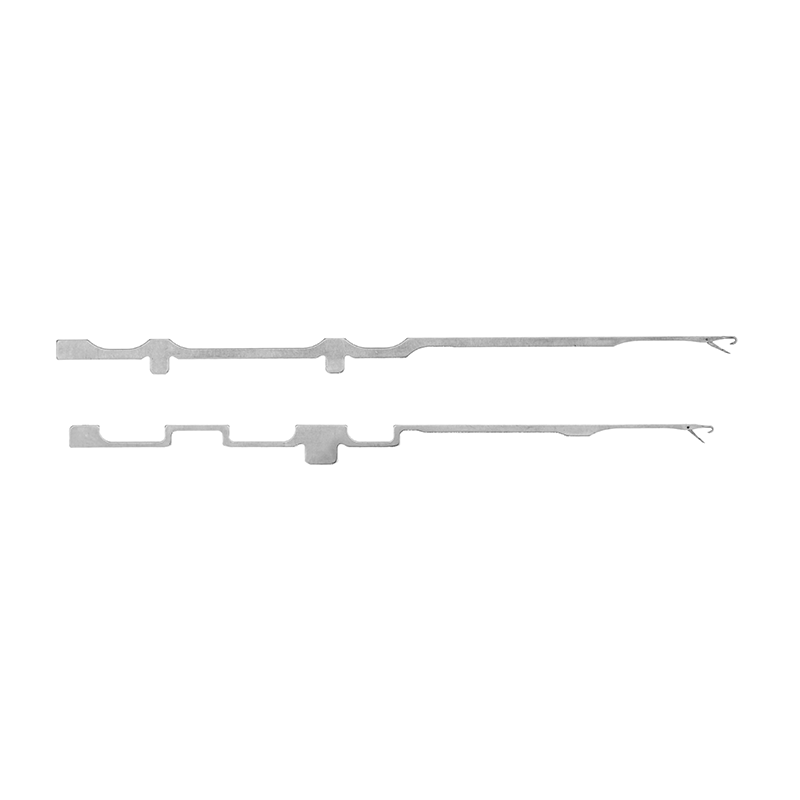
Industrial knitting needles share fundamental anatomical traits regardless of the machine type. The core components include the hook, latch, stem, butt, and tail. The hook catches the yarn to form a new loop during the downward stroke. The latch swings closed to secure the yarn during the stitch cycle, allowing the old loop to cast off. The stem provides structural integrity and dictates the needle's flexibility within the cylinder trick or flatbed slot. The butt interacts directly with the machine cams to drive vertical or horizontal movement. The tail stabilizes the needle, preventing unwanted vibration during high-speed operation.
When a needle butt breaks off inside the cam track, it causes an immediate machine jam. This requires operators to stop the machine, remove the cam box segment, extract the broken metal fragments, and replace the needle. Understanding these individual components helps maintenance teams diagnose fabric defects faster. A bent latch spoon will consistently drop stitches on a specific feeder, while a damaged hook will shear the yarn and cause continuous machine stops.
Tooling lifespan depends entirely on metallurgy and surface treatments. Standard steel needles wear down quickly under high-tension manufacturing. You must match the needle coating to the specific yarn type running on the machine. Running abrasive yarns on standard tooling destroys the needle hooks within days, leading to massive fabric waste and replacement labor.
Coating Type | Wear Resistance | Thermal Dissipation | Ideal Yarn Applications |
|---|---|---|---|
Standard Chrome | Baseline | Moderate | Standard cotton, basic polyester blends, low-tension acrylics. |
Titanium Nitride | High | Excellent | High-speed synthetic runs, spandex blends, activewear yarns. |
Tungsten Carbide | Extreme | High | Kevlar, metallic threads, glass fiber, heavy technical textiles. |
Chrome plating offers baseline wear resistance for standard cotton and polyester blends. Titanium coatings provide superior heat dissipation and structural hardness. You need titanium when running high-speed operations with synthetic yarns that generate static and friction. Tungsten carbide finishes are mandatory when processing abrasive materials. Synthetic, technical, or metallic yarns will shear standard chrome needles rapidly. Proper coating selection prevents microscopic hook abrasions that cause yarn fraying and subsequent machine stops.
The operation of circular knitting needles relies on continuous, unidirectional loop formation. The machine cylinder rotates continuously at high speeds, often exceeding 30 to 40 RPM depending on the diameter. The needle butt engages with a stationary cam box surrounding the cylinder. This interaction forces the needle up to clear the old loop and down to catch new yarn from the feeder.
Sinkers play a critical role in this ecosystem. They move horizontally between the needles, holding the fabric loop down during the needle's clearing phase. This prevents the fabric from riding up with the needle, ensuring uniform stitch formation. The timing between the needle's vertical drop and the sinker's horizontal push must be calibrated perfectly. If the timing is off by even a fraction of a millimeter, the machine will produce uneven loops or cut the fabric entirely.
Flatbed systems utilize a completely different mechanical approach. They operate via a reciprocating, back-and-forth motion driven by a traversing carriage. The needles sit in v-bed configurations, angled toward each other at roughly 90 to 100 degrees. Needle selection happens through jacquard, mechanical, or advanced electronic systems. The carriage cams push the needle butts upward to knit, tuck, or miss based on the programmed pattern.
Flatbed needles often feature specialized transfer springs or slider mechanisms. These additions allow the machine to move stitches between the front and rear beds, enabling complex structural patterns like ribbing, cables, and pointelle. The carriage must physically clear the active needle zone before reversing direction. This mechanical reality dictates the overall production rhythm and requires robust needle stems to handle the sudden directional shifts and variable yarn tension.
Evaluating Circular Knitting Needles vs Flat Knitting Needles requires analyzing output geometry and speed. The fundamental physics of each machine dictate its optimal use case. You cannot force a circular machine to knit fully fashioned panels efficiently. You cannot expect a flatbed machine to match the yardage output of a circular cylinder. Facility managers must align their equipment roster with their primary product categories.
Circular machines produce continuous tubular fabric. This geometry is ideal for high-volume yardage, t-shirts, hosiery, and seamless garments. The fabric rolls off the machine continuously, collected on a take-down roller at the base. You cut and sew the tubular fabric later in the production line. A standard 30-inch diameter machine can produce hundreds of kilograms of fabric per shift.
Flatbed machines produce flat, shaped panels. They excel at fully fashioned garments where the machine knits the exact shape of a sleeve, front panel, or collar. This eliminates cutting waste on the factory floor. Flatbeds can also produce complex 3D structures directly on the machine, such as shoe uppers or technical automotive textiles. The output is measured in completed pieces rather than continuous yardage.
Circular systems deliver high-yield continuous velocity. The unidirectional rotation allows for constant yarn feeding and stitch formation. Multiple feeders operate simultaneously around the circumference of the cylinder. A machine with 90 feeders produces 90 courses of fabric for every single revolution. This compounding effect results in massive daily production volumes.
Flatbed systems face inherent speed limitations. The carriage must decelerate, stop, and reverse direction at the end of every stroke. This reciprocating motion creates dead time. Furthermore, complex stitch transfers require the carriage to move at slower speeds to prevent yarn breakage or needle damage. Even the fastest flatbed machines cannot compete with the raw output volume of a high-RPM circular system. They trade speed for structural versatility.
Both systems support a wide range of gauges, from ultra-fine 40G to coarse 3G. However, their yarn handling differs significantly. Continuous circular knitting maintains steady yarn tension. This steady state allows for high-speed processing of delicate or highly elastic yarns, such as fine denier spandex used in activewear. The yarn path remains relatively static, reducing the risk of sudden snaps.
Reciprocating flat knitting subjects the yarn to variable tension. The yarn stops and starts with every carriage stroke. It is pulled in opposite directions as the carriage moves left, then right. Flatbed needles must handle these sudden tension spikes without dropping stitches or breaking the yarn. Operators must utilize positive yarn feeders and tension arms to mitigate these fluctuations, especially when running brittle yarns like linen or metallic threads.
Selecting the right Industrial Circular Knitting Machine Needles requires understanding their specific operational environment. High-speed continuous rotation places unique mechanical and thermal stresses on the tooling. You must evaluate these needles based on their ability to sustain prolonged, high-velocity operation without degrading fabric quality or requiring premature replacement.
These needles dominate specific manufacturing sectors. Optimal applications include seamless activewear, medical textiles, high-volume jersey, and heavy fleece. Success in these areas depends on strict performance metrics. You must track yards produced per hour. You must monitor the defect rate per roll closely. Machine uptime is the ultimate indicator of needle reliability. Frequent needle changes destroy profitability in high-volume environments.
When running a 28-gauge machine for fine jersey, the needles are incredibly thin and packed tightly together. A single bent latch can cause a continuous vertical line down the entire roll of fabric. Operators must identify and replace the defective needle immediately. Success requires tooling that maintains its structural integrity over millions of stitch cycles.
Standard needles fail rapidly under high RPMs. Advanced engineering solves these velocity issues. Anti-friction latches reduce the mechanical resistance when the loop slides over the spoon. This prevents the latch from snapping off during high-speed clearing. Double-latch systems provide extra security for complex double-knit structures, ensuring the yarn does not escape the hook prematurely.
Conical hooks offer a tapered profile that prevents yarn shearing. When the needle pulls the yarn through the old loop, a standard hook can sometimes scrape the fibers. A conical hook glides smoothly, maintaining yarn integrity. These designs maintain needle stability at high speeds. They ensure the latch closes precisely, preventing dropped stitches and fabric runs that ruin entire rolls of material.
High-speed rotation generates massive friction. The needle butts grind against the stationary cams thousands of times per minute. This friction produces intense heat. Without intervention, metallurgical fatigue sets in, causing the needles to snap at the stem. The heat can also transfer to the yarn, melting synthetic fibers like polyester or nylon directly onto the needle hook.
Automated mist lubrication is mandatory. These systems spray a fine layer of specialized oil onto the needle tracks and cam boxes. The oil reduces friction and acts as a coolant. Oil flushing systems continuously remove lint and metal dust that accumulate in the cylinder tricks. Proper thermal management extends needle life and prevents catastrophic cylinder damage. Operators must monitor oil levels and air pressure constantly to ensure the misting system functions correctly.
Operating circular machines carries specific mechanical risks. Yarn slubs or excessive tension will cause hook breakage and latch failure. High-velocity needle butt impacts lead to premature cam wear. You must implement strict mitigation protocols to protect your equipment and maintain fabric quality.
Enforce rigorous yarn quality controls before feeding the machine. Test yarn cones for tensile strength and inspect for thick slubs that could jam the needle hooks.
Establish regular cylinder cleaning schedules. Use compressed air and specialized flushing oils to remove abrasive lint buildup from the needle tricks.
Calibrate yarn tension meters daily. Ensure all feeders deliver yarn at a uniform tension to prevent uneven pulling on the needle hooks.
Utilize predictive maintenance schedules. Replace the entire set of needles after a specific number of operating hours, rather than waiting for individual needles to fail during a production run.
Inspect cam boxes for wear patterns. Replace worn cams before they cause the needle butts to bounce or misalign during the knitting cycle.
The operational demands for Flatbed Knitting Machine Needles differ entirely from circular systems. These needles must withstand multi-directional forces, complex stitch transfers, and variable carriage speeds. Precision and structural integrity take precedence over raw operational velocity. The tooling must execute intricate mechanical commands flawlessly.
Flatbed systems are the standard for complex structural knitting. Optimal applications include intarsia, heavy cable knits, fully fashioned sweaters, and technical 3D textiles like shoe uppers. Success metrics focus on precision rather than volume. Shaping accuracy is critical for fully fashioned panels. If a needle fails to transfer a stitch during a narrowing sequence, the entire garment panel is ruined.
Stitch transfer reliability determines the quality of cable knits. The needles must stretch the yarn across multiple beds without breaking the fibers. Minimal yarn waste is a primary financial driver for adopting flatbed technology. By knitting exactly to shape, factories eliminate the fabric scraps associated with cut-and-sew operations. The needles must support this zero-waste objective by operating without errors.
Flatbed needles execute complex mechanical maneuvers. They handle racking, where the needle beds shift laterally to create angled stitches or zig-zag patterns. They manage widening and narrowing for garment shaping, transferring stitches inward or outward to change the panel width. Pointelle patterns require precise stitch transfers to create deliberate holes in the fabric structure.
Slider needles often replace traditional latch needles in advanced flatbeds. Sliders use a secondary sliding element to close the hook, eliminating the swinging latch. This optimizes stitch transfer efficiency. The slider securely holds the loop while the opposing needle enters the space to take the stitch. This mechanism allows for shorter carriage stroke distances and faster transfer speeds. Flatbed needles must absorb the stress of multi-directional yarn pulling during these complex structural knits.
Reciprocating systems introduce unique operational hazards. Dropped stitches or yarn buildup frequently cause carriage jams. When the carriage hits a jammed needle at full speed, it can severely damage the needle bed, break multiple cams, and ruin the tooling. Slower production yields can negatively impact output on high-volume orders.
Utilize electronic needle selection for precise, error-free control. Ensure the software mapping matches the physical needle arrangement exactly.
Optimize carriage speed profiles. Program the machine to slow down during complex transfers or heavy cable crosses to reduce stress on the needle hooks.
Maintain rigorous environmental dust control. Install overhead fans and vacuum systems to prevent lint from jamming the needle tricks and interfering with the slider mechanisms.
Inspect transfer springs regularly. A bent spring will fail to open the loop for the receiving needle, causing a dropped stitch and a potential carriage crash.
Tooling selection directly impacts facility workflows and resource allocation. You must evaluate the broader logistical implications of your needle systems. Equipment investment, maintenance labor, and utility loads vary drastically between machine types. Aligning your machinery with your workforce capabilities ensures smooth daily operations.
Maintenance labor impacts facility output. Replacing a full set of circular needles is a massive, time-consuming task. A large diameter machine can hold over 3,000 needles. Replacing them halts production entirely for a full shift. However, circular needles generally wear evenly, allowing for scheduled full-cylinder replacements. This predictability helps managers plan downtime effectively.
Flatbed maintenance involves troubleshooting individual needle failures. A single bent latch can ruin a shaped panel. Operators must stop the machine, locate the specific defective needle, and replace it immediately. Lubrication requirements also differ. Circular machines consume large volumes of specialized misting oils. You must manage the storage of this oil and ensure proper ventilation on the factory floor. Flatbed machines require targeted lubrication along the carriage tracks and needle beds, using thicker oils or greases that do not mist into the air.
Needle friction directly correlates to energy consumption. In circular systems, thousands of needle butts dragging through cam tracks create immense physical resistance. The main drive motor must draw significant power to maintain high RPMs against this friction. If the lubrication system fails, the friction spikes, and the motor draws even more amperage, potentially tripping circuit breakers.
Flatbed systems draw variable power. The motor surges during carriage acceleration and drops during deceleration. Heavy structural knits increase the motor load as the needles fight against high yarn tension. Knitting a tight, multi-color jacquard pattern requires more energy than knitting a loose, single-color jersey. You must factor these utility loads into your facility's electrical infrastructure planning.
Sourcing reliable tooling is a strategic imperative. You must evaluate needle manufacturers rigorously. Look for vendors providing strong technical support and custom engineering capabilities. Metallurgical consistency is non-negotiable. A bad batch of improperly tempered needles will snap under tension, destroying your production schedule and damaging your cam boxes.
Assess global lead times. Tooling shortages cause immediate factory downtime. If you run specialized slider needles, you cannot easily substitute them with generic latch needles. Partner with vendors who maintain robust inventory levels and offer rapid shipping for emergency replacements. Establish a localized safety stock of your most critical needle types to buffer against supply chain disruptions.
Your tooling choice dictates your scalability strategy. Scaling via multiple high-speed circular machines makes sense for stable, high-volume commodity markets. It maximizes yardage output per square foot of factory space. You can train operators to manage multiple circular machines simultaneously, as they require less frequent intervention during a stable run.
Investing in versatile, automated flatbed systems makes sense for volatile, trend-driven markets. Flatbeds allow you to pivot quickly between different garment styles, sizes, and complex patterns without retooling an entire cylinder. You simply load a new digital pattern file and adjust the yarn feeders. This flexibility allows manufacturers to accept smaller, high-margin orders and respond rapidly to changing fashion trends.
Consult with tooling engineers to audit your current yarn specifications and tension requirements before purchasing new needle sets.
Request detailed metallurgical data sheets from prospective needle manufacturers to verify coating durability against your specific yarn types.
Run small-batch tension and speed tests using sample needles to monitor heat generation and wear before executing full-scale procurement.
Implement a standardized daily cleaning and lubrication protocol to remove abrasive lint and extend the lifespan of your selected tooling.
A: Lifespan depends on operating hours, RPM, and yarn abrasiveness. Under standard conditions with cotton yarn and proper mist lubrication, needles can last 4 to 6 months. Processing abrasive synthetic or metallic yarns at high speeds can reduce lifespan to weeks. Strict adherence to lubrication standards prevents premature metallurgical fatigue.
A: Yes. Advanced flatbed machines utilize whole-garment or knit-and-wear technology. By using specialized v-bed configurations and complex stitch transfer techniques, the needles can knit complete, seamless 3D garments directly on the machine, eliminating the need for post-production cutting and sewing.
A: Prevent latch breakage by calibrating yarn tension precisely. Enforce strict yarn quality controls to eliminate slubs that force the latch backward. Utilize advanced anti-friction latch designs. Maintain accurate machine timing to ensure the latch clears the loop without mechanical interference.
A: Circular gauge is measured in needles per inch (NPI) along the circumference of the cylinder. Flatbed gauge is determined by the needle bed pitch, measuring the distance between the needle slots (tricks) on the flat metal bed. Both dictate the fineness of the resulting fabric.
A: Tungsten carbide and titanium coatings are optimal for abrasive materials. They provide superior Rockwell hardness compared to standard chrome. These coatings handle technical textiles, Kevlar, and metallic threads effectively. They resist microscopic scratching, preventing premature wear and subsequent yarn fraying.
A: Circular systems generate continuous, high-heat friction requiring constant mist lubrication and oil flushing. Flatbed systems experience reciprocating, variable-stress friction. Flatbeds require targeted lubrication along the carriage tracks and needle beds to prevent lint buildup and manage the intermittent mechanical impacts without over-oiling the fabric.
A: Needle lines result from mechanical inconsistencies. Bent needle hooks, stiff latches, or uneven cam settings cause irregular stitch sizes. Inconsistent needle metallurgy within the same cylinder also creates tension variations. Regular cylinder audits and replacing worn needles immediately resolves barre defects.