
English ![]()

No.7 Wolong Middle Road, Wolong Economic Park, Zhifu District, Yantai City, Shandong Province

Views: 0 Author: Site Editor Publish Time: 2026-09-09 Origin: Site
A flat knitting needle is easy to identify by shape, but its size is not described by one number alone. In industrial flat knitting, two different specifications are often discussed together: the physical size of the needle and the gauge of the knitting machine. They influence each other, yet they are not interchangeable.
Gauge tells you how many needle positions are arranged across a given width of the needle bed. Needle size describes the geometry of the individual needle, including its shank, hook, latch, butt, and overall profile. Understanding that distinction is essential when reading specifications, comparing replacement parts, or discussing compatibility with a supplier.
The simplest way to separate the terms is to ask two different questions.
Gauge asks: how closely are the needles arranged in the machine?
Needle size asks: what are the dimensions and geometry of each needle?
For modern flat knitting machines, gauge is commonly expressed as E or G. STOLL defines gauge E as the number of needles in one English inch, or 25.4 mm, in one needle bed. That means a 12-gauge bed places 12 needle positions within approximately one inch, while a 5-gauge bed has much wider spacing.
The physical flat knitting needle, however, still needs its own product specification. Two needles can belong to machines with the same nominal gauge and still differ in shank dimensions, butt position, hook form, latch design, or transfer geometry.
Once gauge is understood as needles per inch, the spacing becomes easier to visualize. A useful theoretical relationship is:
Needle pitch ≈ 25.4 mm ÷ gauge
As the gauge number rises, the theoretical space between needle positions becomes smaller.
| Machine Gauge | Approx. Needle Pitch | General Interpretation |
|---|---|---|
| 5G | 5.08 mm | Coarse spacing |
| 7G | 3.63 mm | Medium spacing |
| 9G | 2.82 mm | Medium spacing |
| 12G | 2.12 mm | Fine spacing |
| 14G | 1.81 mm | Fine spacing |
| 16G | 1.59 mm | Finer spacing |
SHIMA SEIKI groups 3–5 gauge as coarse or low gauge, 7–10 as middle gauge, and 12–21 as fine or high gauge. This classification helps describe machine scale, but not the exact replacement needle model.
XINYANG also lists related computerized flat-knitting components for gauges such as 5G, 7G, 9G, 12G, 14G, and 16G, showing how gauge is used throughout the machine system to describe compatibility.
When buyers say “needle size,” overall length is often the first dimension they think about. For a flat knitting needle, that is only part of the specification.
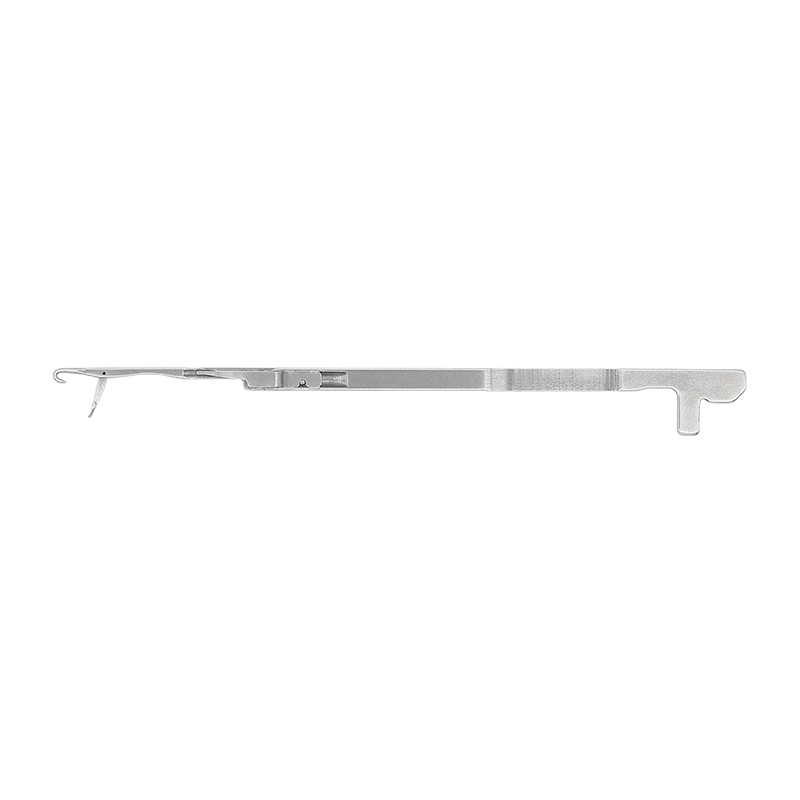
The shank determines how the needle sits and travels in the needle trick. The butt is the section acted on by the cam system, so its location, height, and shape affect needle movement. The hook must capture the yarn correctly, while the latch must open and close through the loop-forming cycle.
Because these elements work together, two needles of similar total length can still be completely different parts.
XINYANG’s flat knitting needlecategory reflects this model-based approach. The company lists specific needle families rather than treating gauge as the only identifier. Its current range includes 80.85 and 89.75 needle products for computerized knitting applications.
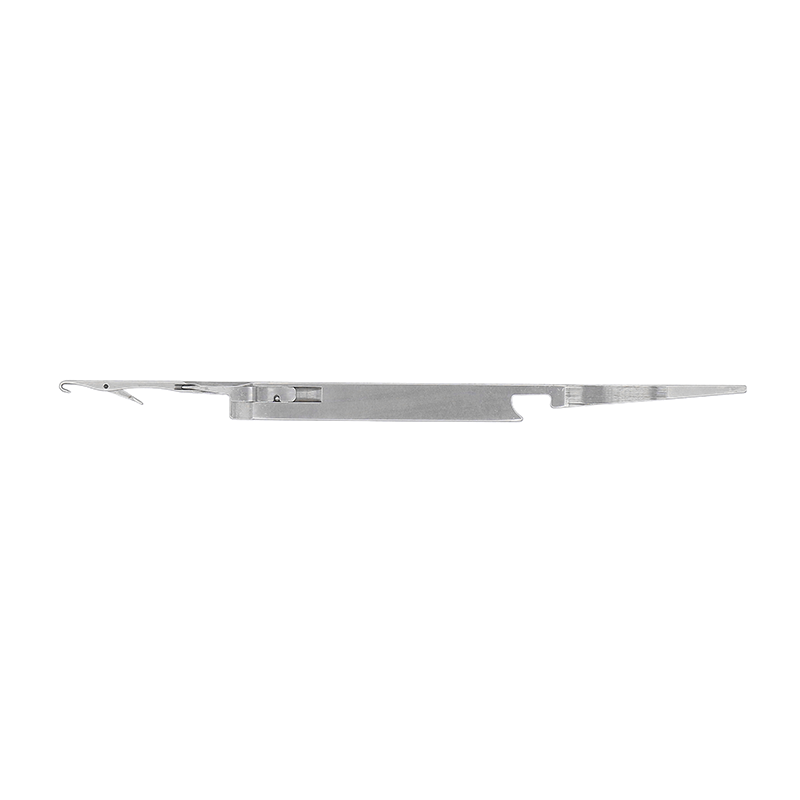
One of the most common mistakes is assuming every number printed on a needle package represents gauge.
Consider XINYANG’s 89.75 Needle for Flat Knitting Machine. The official model is:
Vosa-Spec. 89.75-64T0016
Here, 89.75 forms part of the model designation. It should not be read as 89.75G or converted into a machine-gauge value. XINYANG also specifies high-carbon chromium steel, nickel plating, and a sharpened precision tip for this product.
Industrial needle codes may contain numbers from a manufacturer’s own product system. Read them together with machine gauge, machine model, physical dimensions, and the complete needle code rather than treating one number as a universal size.
The XINYANG 80.85 needle family provides a useful example of a true physical needle measurement.
Its official product information lists a needle shank diameter of 1.2 mm ± 0.01 mm. The page identifies the FHSASPEC 80.85D (D) version for flat knitting machines and the VOSASPEC 80.85D (J) version for circular knitting machines.
That 1.2 mm value is a physical dimension. It describes part of the needle itself.
By contrast, a value such as 12G describes the density of needle positions in a machine bed.
So the two numbers answer different questions:
1.2 mm describes the needle.
12G describes the needle-bed spacing.
This is the core difference between flat knitting needle size and machine gauge.
Not automatically, but higher gauge does mean that needle positions are closer together.
A 16G machine has a smaller theoretical needle pitch than a 7G machine because more needle positions must fit within the same inch. The compatible needle system must therefore be designed for that finer bed geometry.
However, every high-gauge machine does not use one standard “small needle.” Manufacturers can use different hook shapes, butts, transfer structures, and needle-bed designs.
The accurate relationship is:
higher gauge = closer needle spacing
not:
higher gauge = one specific needle size
A universal chart converting 5G, 7G, 12G, or 16G directly into one replacement needle model would therefore be misleading.
Gauge defines density, not the entire mechanical system.
Two machines can both be described as 12G, yet one may use a different needle butt position or transfer arrangement from the other. The hook profile may also differ according to the needle system.
STOLL’s spare-parts documentation reinforces this distinction by requiring machine type, gauge, and machine identification when ordering parts. Gauge is necessary information, but it is not sufficient by itself.
A request such as “I need a 12G flat knitting needle” may therefore be incomplete; a reliable match also needs the machine model and original needle reference or sample.
If two needles need to be compared, start with their full profile rather than only the number printed on the package.
Check overall length, shank size, butt position, butt height, hook geometry, latch geometry, and any transfer-related section. The complete model code should also be compared.
For products such as XINYANG’s 80.85 Needle, the official specification provides a measurable shank dimension and identifies separate model variants for flat and circular knitting applications. That level of information is more useful than assuming visually similar needles are interchangeable.
Gauge becomes especially useful when comparing the general scale of different machine systems.
A coarse-gauge machine provides more space between needle positions, while a fine-gauge machine places many more needle positions across the same bed width. This affects the geometry available to the needle and surrounding components.
It also explains why gauge appears in the specifications of other flat-knitting parts. XINYANG’s computerised flat-knitting jack range, for example, includes specifications associated with 5G, 7G, 9G, 12G, 14G, and 16G machine applications.
That does not mean the jack gauge number defines needle size. Instead, it demonstrates that gauge is a system-level characteristic: the needle, needle bed, jack, and related control parts must all be designed to work within the required machine geometry.
For SEO searches such as flat knitting needle size chart, flat knitting machine gauge, or 12G flat knitting needle, this distinction is particularly important. A simple numerical size chart can explain needle spacing, but it cannot replace machine-specific needle identification.
Gauge indicates the number of needle positions per English inch, or 25.4 mm, in the needle bed. A higher gauge means closer needle spacing.
No. Gauge describes the machine bed. Needle size describes the dimensions and geometry of the individual needle.
No. The “12” in 12G represents needle density, not a 12 mm needle measurement. Using the basic gauge relationship, 12G corresponds to a theoretical needle pitch of approximately 2.12 mm.
On XINYANG’s 89.75 product, it is part of the model designation Vosa-Spec. 89.75-64T0016. The company does not present 89.75 as the machine gauge.
Yes. Machines with the same nominal gauge can still use different needle geometry, butt arrangements, transfer features, or machine-specific needle systems.
Useful checks include overall length, shank dimensions, butt position and height, hook profile, latch geometry, and the complete product code.
Choosing the right flat knitting needle means matching machine gauge, needle dimensions, material, and application requirements rather than relying on model numbers alone. A properly matched needle can help improve machine stability, maintain consistent stitch formation, and support reliable fabric quality.
Yantai Xinyang Electronics supplies precision flat knitting needles and related knitting machine components for industrial textile applications. For help with needle selection, gauge compatibility, replacement parts, or product specifications, explore XINYANG’s flat knitting needle range or contact the team for technical support and quotation assistance.
The conclusion already emphasizes correct needle selection and XINYANG’s product support, while adding a concise SEO meta description for this article would extend its search visibility without repeating the body content.


